The Importance of Fire Alarm Cables

There are few things more important than fire safety. Without the proper fire electrical equipment set up in a small home or a big building, one small fire that starts anywhere in the building can cause a huge safety issue. According to the National Fire Protection Association, an average of seven people die from fires on a daily basis. The fact that this could be prevented makes the situation that much worse. When any type of building gets ready for people to move into it, whether it’s to work or to live, one of the most important things to check is fire safety. Fires spread like no other, so ensuring that the building has the proper fire safety tools to help prevent fires from starting and spreading with no warning to the other occupants in the building is a major factor in the overall safety of the building.

Besides actually having a smoke or fire detector in place, one of the most important things all fire alarms need to have to ensure the safety of the building’s occupants is the proper setup of fire alarm cables. Fire alarm cables have a significant importance in the setup of fire alarm systems. They carry signals from room to room and aid in sounding the alarm in order to warn the occupants of the building that there is a fire somewhere and an evacuation needs to occur. Now, with the different types of fire alarm cables out there, it may seem hard to choose the right one to best fit your needs. That is where EWCSWire comes in. With a variety of wires and cables to choose from, our Electric Wire and Cable Specialists are ready at hand to help you choose the best cable for your job.

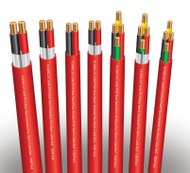
At EWCSWire, we carry four different types of cables: FPLR Riser Rated, FPLR Shielded Riser Rated, FPLP Plenum Rated, and FPLP Shielded Plenum Rated. Shielded cables are more durable and recommended for use with longer-reaching systems where there might be interference. Non-shielded cables are better suited for simpler, shorter-reaching systems and are less expensive than shielded cables. Riser cables are used vertically, in non-plenum floor spaces. Plenum cables, on the other hand, are used in the spaces between the structural ceiling and drop-down ceiling where air circulation for heating, ventilation, and air-conditioning sits. Because of its location, plenum cables have a higher fire resistance and emit less toxic fumes if they come into contact with fire. If you are looking to only order one type of cable, plenum cables can be used to replace riser cables. However, riser cable cannot replace plenum cables.

When it comes to the safety of others, here at EWCSWire, we don’t mess around. Our expert staff is fully knowledgeable on all electrical wires and cables and are eager to answer all of your questions to help lead you on the path to finding the proper cables to safely finish your job. All of our fire alarm cables are USA made with the highest quality products and manufacturing standards. We ship orders within 24 hours from our multiple fulfillment centers with an estimated delivery of two to five business days. So visit our website and contact us today to let us help you create safe environments for everyone!

Comments

Popular posts from this blog

Common Questions About Security and Alarm Cables, Answered

Not sure which type of security or alarm cable your facility or system needs? Hopefully, these answers to common questions can help! What cable is used for alarm systems? Security and alarm systems are usually wired with small-gauge wire specifically designed for the purpose. For instance, many security systems are wired with 12 and 18 AWG gauge alarm wire, as these low-voltage applications do not necessarily require larger, heavier wires. However, larger or wire gauges may be required depending on the circumstances. Also, there are some unique requirements for some systems. For instance, fire alarm cables must be made with specific insulation that is heat resistant and which does not produce toxic smoke when burned. What gauge cable do you need for alarm systems? Only your specific system requirements can answer that question, but often large wire gauges (that is, smaller wires) are used as security and alarm cables because of the low-voltage, low-current application. What is ...

Marine Battery & Cable Maintenance

Your boat’s battery is necessary to start the engine, power the electrical system, including lights and navigation, and much more. For boats powered by a trolling motor, it i the only power source for the vessel. Without it, you would be dead in the water. With that said, here are some high-level ways to take care of your marine battery and cables. Protect and Clean the Terminals The easiest aspect of marine battery maintenance is to keep the terminals clean. Over time, discharge will exude from the terminals, and this corrosion can damage the battery and make it difficult to establish a solid electrical connection. Use a solution of warm water and baking soda with a battery terminal brush or a steel wire brush to scrub them clean from time to time. Then, apply some dielectric grease to the terminals. A thin coating will help prevent water ingress and almost entirely prevent corrosion. Keep the Battery Charged A fully charged battery will last longer than one that is fully...

Qualities to Look for in Good 10 AWG Marine Primary Wire

Regardless of your level of experience as a mariner, you are likely to have improvements you’d like to make to your boat. Whether these improvements come in the form of a new radio, a cutting-edge fish-finder, or a more personalized control panel, each one will require some electrical work in order to bring power from your boat’s battery to the system. For this, you are likely to require at least some length of 10 AWG marine primary wire . Choosing good quality wire, however, can be difficult if you don’t know exactly what to look for. In this blog, we will help you know exactly what to look for to ensure you get the wire you need. 1. Quality Insulation When shopping for 10 AWG marine primary wire, the most important characteristic of good wire is quality insulation. With marine electrical systems, it is remarkably important that moisture, salt, and minerals are kept completely separate from the copper that makes electrical systems possible. This is achieved with mar...