
The Right Cables Get the Job Done Fast

Choosing and maintaining the right welding cable is crucial to your success. How can you ensure that the one you have chosen is the right one for your job and that it is safe and effective to use? With dozens of brands, materials, and sizes, it can seem like there are an overwhelming amount of choices out there. You need a cable that is cost-effective, reliable, and of course, safe, so you can rest easy that your gear will keep you and your clients happy. But what specific knowledge do you need in order to be certain you are choosing the right cable? There are several important features that anyone who works with welding equipment should know in order to make sure they have the right cables for the job.
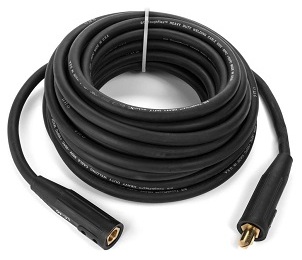

The first item to consider is the cable’s material. Welding cables are typically made from copper or aluminum and knowing the difference is an important part of getting your job done right. Copper is a better conductor of electricity than aluminum and requires less maintenance. It can be safer to use than aluminum and there is less risk of causing a fire. Balancing costs with quality as an important practice for your business but keep in mind the differences between the two wires is very distinct.

Be sure that you are selecting the correct gauge for your welding cable as well. Just like how a garden hose of a larger diameter can pass more water, a larger cable can pass more electricity. Be sure that the cable you choose is the correct one for the job you need to do. Length, too, is an important factor. A shorter cable run is rated for more ampacity than a longer cable run. We have a handy chart to help you size your welding cable appropriately.

There are two things one needs to know in order to choose the right cable for welding. The first of these is how long the welding circuit is. This simply means that you need to know the whole path your cable is following. Next, you will need to know the maximum amperage you will use. This is often found on your welding machine and easily accessible.

At EWCSWire, we know how important it is to have the right tools and cables for the job you are about to undertake. Our years of experience place us at the forefront of the industry enabling us to assist you in any job, big or small, that comes your way. Whether you need help choosing the correct cable size, you are not sure if you should choose aluminum or copper, or you simply do not yet know what tools you will need, be sure to ask our experts and we will get you back to work in a fast, safe, and reliable way so that you get the job done right.

Comments

Popular posts from this blog

Common Questions About Security and Alarm Cables, Answered

Not sure which type of security or alarm cable your facility or system needs? Hopefully, these answers to common questions can help! What cable is used for alarm systems? Security and alarm systems are usually wired with small-gauge wire specifically designed for the purpose. For instance, many security systems are wired with 12 and 18 AWG gauge alarm wire, as these low-voltage applications do not necessarily require larger, heavier wires. However, larger or wire gauges may be required depending on the circumstances. Also, there are some unique requirements for some systems. For instance, fire alarm cables must be made with specific insulation that is heat resistant and which does not produce toxic smoke when burned. What gauge cable do you need for alarm systems? Only your specific system requirements can answer that question, but often large wire gauges (that is, smaller wires) are used as security and alarm cables because of the low-voltage, low-current application. What is ...

Marine Battery & Cable Maintenance

Your boat’s battery is necessary to start the engine, power the electrical system, including lights and navigation, and much more. For boats powered by a trolling motor, it i the only power source for the vessel. Without it, you would be dead in the water. With that said, here are some high-level ways to take care of your marine battery and cables. Protect and Clean the Terminals The easiest aspect of marine battery maintenance is to keep the terminals clean. Over time, discharge will exude from the terminals, and this corrosion can damage the battery and make it difficult to establish a solid electrical connection. Use a solution of warm water and baking soda with a battery terminal brush or a steel wire brush to scrub them clean from time to time. Then, apply some dielectric grease to the terminals. A thin coating will help prevent water ingress and almost entirely prevent corrosion. Keep the Battery Charged A fully charged battery will last longer than one that is fully...

Qualities to Look for in Good 10 AWG Marine Primary Wire

Regardless of your level of experience as a mariner, you are likely to have improvements you’d like to make to your boat. Whether these improvements come in the form of a new radio, a cutting-edge fish-finder, or a more personalized control panel, each one will require some electrical work in order to bring power from your boat’s battery to the system. For this, you are likely to require at least some length of 10 AWG marine primary wire . Choosing good quality wire, however, can be difficult if you don’t know exactly what to look for. In this blog, we will help you know exactly what to look for to ensure you get the wire you need. 1. Quality Insulation When shopping for 10 AWG marine primary wire, the most important characteristic of good wire is quality insulation. With marine electrical systems, it is remarkably important that moisture, salt, and minerals are kept completely separate from the copper that makes electrical systems possible. This is achieved with mar...