
The Right Cables Get the Job Done Fast

Choosing and maintaining the right welding cable is crucial to your success. How can you ensure that the one you have chosen is the right one for your job and that it is safe and effective to use? With dozens of brands, materials, and sizes, it can seem like there are an overwhelming amount of choices out there. You need a cable that is cost-effective, reliable, and of course, safe, so you can rest easy that your gear will keep you and your clients happy. But what specific knowledge do you need in order to be certain you are choosing the right cable? There are several important features that anyone who works with welding equipment should know in order to make sure they have the right cables for the job.
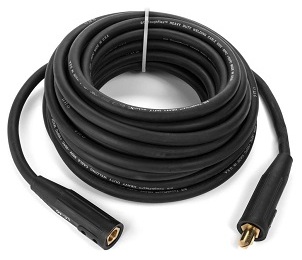

The first item to consider is the cable’s material. Welding cables are typically made from copper or aluminum and knowing the difference is an important part of getting your job done right. Copper is a better conductor of electricity than aluminum and requires less maintenance. It can be safer to use than aluminum and there is less risk of causing a fire. Balancing costs with quality as an important practice for your business but keep in mind the differences between the two wires is very distinct.

Be sure that you are selecting the correct gauge for your welding cable as well. Just like how a garden hose of a larger diameter can pass more water, a larger cable can pass more electricity. Be sure that the cable you choose is the correct one for the job you need to do. Length, too, is an important factor. A shorter cable run is rated for more ampacity than a longer cable run. We have a handy chart to help you size your welding cable appropriately.

There are two things one needs to know in order to choose the right cable for welding. The first of these is how long the welding circuit is. This simply means that you need to know the whole path your cable is following. Next, you will need to know the maximum amperage you will use. This is often found on your welding machine and easily accessible.

At EWCSWire, we know how important it is to have the right tools and cables for the job you are about to undertake. Our years of experience place us at the forefront of the industry enabling us to assist you in any job, big or small, that comes your way. Whether you need help choosing the correct cable size, you are not sure if you should choose aluminum or copper, or you simply do not yet know what tools you will need, be sure to ask our experts and we will get you back to work in a fast, safe, and reliable way so that you get the job done right.

Comments

Popular posts from this blog

Two Important Things You Need to Know About Marine Electrical Wire

Do you own a boat? Are you a member of a ship’s crew? Are you a ship’s mechanic or an electrician by trade? If you answer yes to any of these questions, you will at some point or other come across marine electrical wire in the course of your career. Something important you’ll need to keep in mind is that marine electrical cable and wire is not the same as standard building wire; nor is it the same as automotive battery wire. Here are the two big defining traits. Marine Electrical Wire Is Highly Flexible If there’s one thing you need to know about marine electrical wire (also sometimes called marine battery cable or marine battery wire) it’s that it’s highly flexible. This is accomplished by making these conductors out of very high strand counts of very thin conductors. Typically, marine battery wire conductors are made from pure, 100% copper and each conductor is very thin. Doing so makes the cable very flexible. Why is this necessary? Well, ...

Common Questions About Security and Alarm Cables, Answered

Not sure which type of security or alarm cable your facility or system needs? Hopefully, these answers to common questions can help! What cable is used for alarm systems? Security and alarm systems are usually wired with small-gauge wire specifically designed for the purpose. For instance, many security systems are wired with 12 and 18 AWG gauge alarm wire, as these low-voltage applications do not necessarily require larger, heavier wires. However, larger or wire gauges may be required depending on the circumstances. Also, there are some unique requirements for some systems. For instance, fire alarm cables must be made with specific insulation that is heat resistant and which does not produce toxic smoke when burned. What gauge cable do you need for alarm systems? Only your specific system requirements can answer that question, but often large wire gauges (that is, smaller wires) are used as security and alarm cables because of the low-voltage, low-current application. What is ...

How to Select the Right Welding Cable for the Job

Before you go on a search to determine the best welding cable for the job, you may need to know exactly what it is. A welding cable works as the electrical conductor for the current produced from the welding through a series of copper strands wrapped inside a non-conductive covering or jacket. Copper is a better choice as a conductor, like we use in our 6 gauge welding cable at EWCS, because it has higher tensile strength and higher conductivity than other products, such as aluminum. Not only is copper a better conductor than products like aluminum, but it also tends to be more resistant to corrosion. Our 6 gauge welding cable has approximately 259 strands of 100% copper that allows it to be the best conductor. Our largest gauge welding cable has over 2000 strands of 100% copper that makes it the best for its size. So when purchasing the right welding cable, make sure that it is made with copper, like our selection of welding cables. Choosing the Proper Size when determinin...