
Buying Quality Marine Electrical Wire

When it comes to wiring in marine environments, you have to start with a new set of rules. The American Boat and Yacht Council (ABYC) has its own set of guidelines that differ significantly from wiring in terrestrial applications. Before you start your next marine wiring project, it’s important to reference these guidelines to ensure you are using the proper marine electrical wire and proper terminal connections to avoid the possibility of potentially catastrophic electrical failure. Knowing what to look for before you purchase your wire can help ensure that your boat is wired safely.
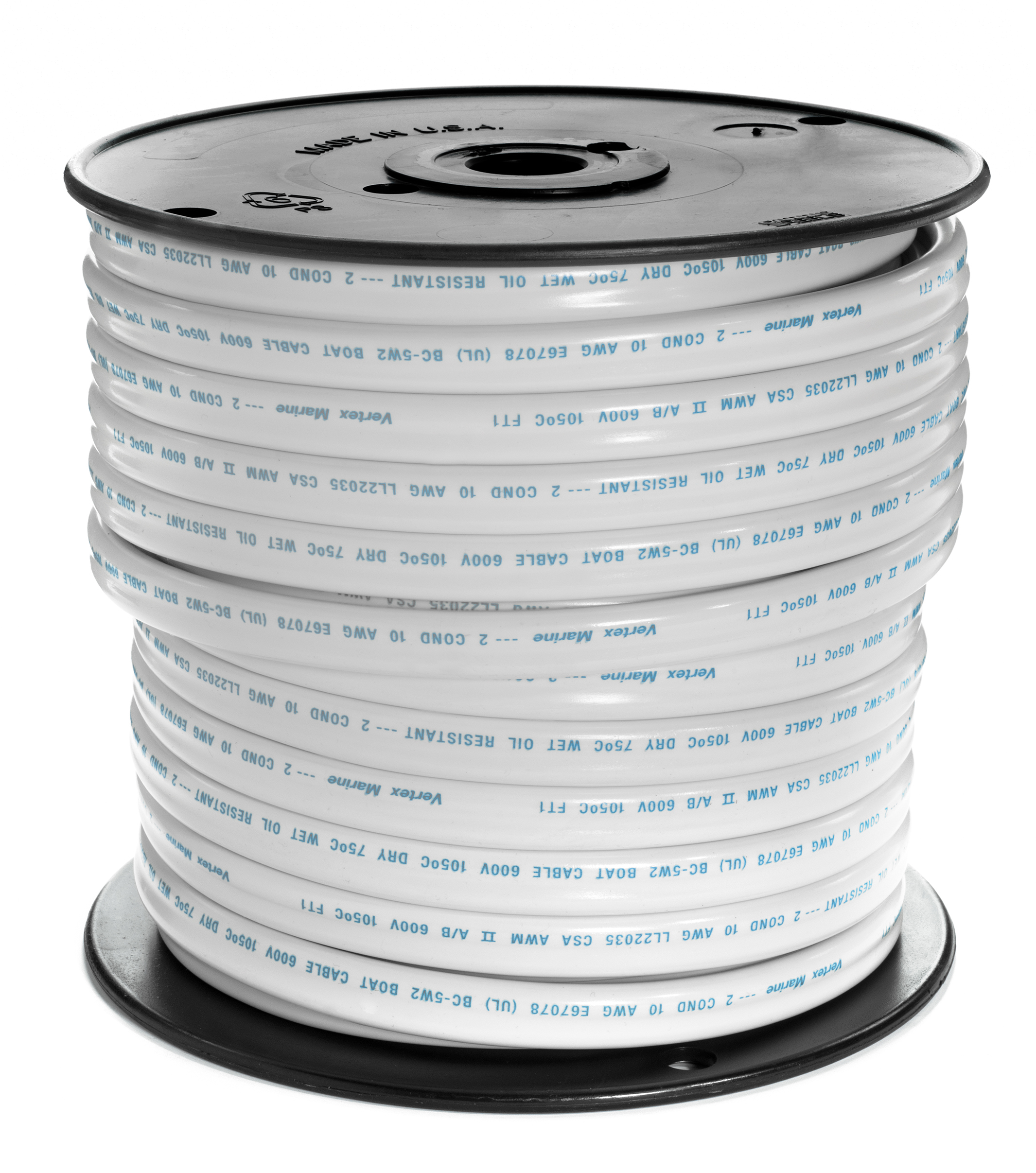
Marine environments have to deal with a lot of movement. Between the gentle rocking that experienced in your dock or harbor to the violent jarring when cutting through the waves, boats almost never standstill. Because of all this movement, it’s crucial to have flexible cables that can move without cracking their insulation or coming disconnected. In order to achieve this level of flexibility, marine electrical wires should use finely stranded conductors instead of a single solid copper core.

Though it is not officially frowned upon by the ABYC, using solid copper conductors for marine wiring can cause any exposed conductors to corrode. To avoid this corrosion, many manufacturers choose to make their marine cables using tinned copper. When you electroplate your copper strands with tin, the resulting conductor maintains excellent conductivity with a much lower reactivity. In marine environments where water and salt are common, these coated conductors will help avoid corrosion and will greatly increase the lifespan of your cables.

Another layer of protection that marine cables require is a high gradelayer of insulation. The engine room of a boat can contain water, gasoline, oil, abrasive surfaces, and other potentially corrosive substances. The PVCinsulationon your marine cables has to be able to stand up to any of these potentially damaging agents. If your insulaton is weakened by solvents like gasoline or oil it can break down, your cables can easily end up with exposed conductors and suffer from corrosion.

When you are installing your wires it is important to make sure you are using the correct terminals. All of the movement on boats can easily cause traditional terminals to vibrateloose. Terrestrial connections like wire nuts require at least one of the wires to feature a solid conductor, which makes them a poor choice for marine wiring. Instead, screw-in terminals should be employed for extra security. Wires should end in ring terminals and need to be securely crimped and secured with a shrink tube. This will create a remarkably stable connection that will not shake loose over time.

If you need the highest quality marine electrical wire, visit EWCS Wire today. We are an American manufacturer of high-quality wire and cable for a wide range of applications. Our marine wires and cables feature tinned copper stranded conductors and rugged insulators. If you are about to undertake a marine electrical project, be sure to review the ABYC guidelines and purchase quality marine wire from EWCS today.

Comments

Popular posts from this blog

Common Questions About Security and Alarm Cables, Answered

Not sure which type of security or alarm cable your facility or system needs? Hopefully, these answers to common questions can help! What cable is used for alarm systems? Security and alarm systems are usually wired with small-gauge wire specifically designed for the purpose. For instance, many security systems are wired with 12 and 18 AWG gauge alarm wire, as these low-voltage applications do not necessarily require larger, heavier wires. However, larger or wire gauges may be required depending on the circumstances. Also, there are some unique requirements for some systems. For instance, fire alarm cables must be made with specific insulation that is heat resistant and which does not produce toxic smoke when burned. What gauge cable do you need for alarm systems? Only your specific system requirements can answer that question, but often large wire gauges (that is, smaller wires) are used as security and alarm cables because of the low-voltage, low-current application. What is ...

Looking To Bulk Up On Cables and Wires?

Do you feel that you’ve got the materials that you need to do your job correctly? If you know exactly what you’ll be working with, it’s always smart to keep a decent amount of cables and wires on hand. That way, you won’t risk putting off a job to wait for supplies. The best place for you to stock up on your cables and wires is EWCSWire.com. At EWCSWire, we’ve been selling cables and wires and cable and wire accessories for well over twenty years. Since 1994, we’ve been a leader in the industry, providing the highest quality products to needy customers and technicians around the country. With welding cable for sale , you’d be hard pressed not to take advantage of the great bargains that EWCSWire has to offer! There are quite a lot of options to choose from too, so when EWCSWire says we having welding cable for sale, we mean any welding cable that you need to finish your project! If you work in the industry, you understand that cable costs can accumulate, leaving a pretty heft...

Things To Look Out For When Looking For Welding Cable For Sale

Are looking for a welding cable for sale online? If you are, then you must be aware of what they are designed for—not for an undemanding profession, that’s for sure. Welding cable is designed for electric arc-welding machines, it is a conductor that carries the power to fire up the metal rod so that a welding professional can get the work done. However, for a welding cable to properly perform what’s it supposed to do, it should meet the right standards for it to be strong enough to perform its job. Why Must a Welding Cable be Durable? This job is not for the weak and that’s not limited to the professional himself but the cable as well. It’s important to know that you’re getting nothing but the most durable and flexible welding cable there is. There’s a current passing through those wires after all. The last thing you need is for your welding cable to overheat, impeding a speedy welding process. You also don’t want your welding cable to ...