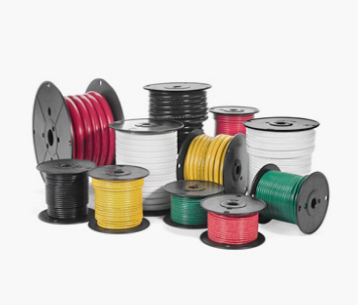
How to Select the Right Welding Cable for the Job

Electrical Wire & Cable Specialists
Before you go on a search to determine the best welding cable for the job, you may need to know exactly what it is. A welding cable works as the electrical conductor for the current produced from the welding through a series of copper strands wrapped inside a non-conductive covering or jacket. Copper is a better choice as a conductor, like we use in our 6 gauge welding cable at EWCS, because it has higher tensile strength and higher conductivity than other products, such as aluminum. Not only is copper a better conductor than products like aluminum, but it also tends to be more resistant to corrosion. Our 6 gauge welding cable has approximately 259 strands of 100% copper that allows it to be the best conductor. Our largest gauge welding cable has over 2000 strands of 100% copper that makes it the best for its size. So when purchasing the right welding cable, make sure that it is made with copper, like our selection of welding cables.

Choosing the Proper Size

when determining the correct size or gauge of a welding cable, you have to determine the welding cable capacity or amperage rating, which describes how much electrical current a cable can handle. When you are purchasing a welding cable, it’s important to keep in mind that a maximum temperature is also added to the welding cable rating. For example, this welding cable is a 6 gauge welding cable made entirely of copper, and is rated 600 volts -50C + 105C and comes in various sizes with a nominal diameter of .320”. It gives you all the information you are looking for in terms of how many volts it can handle as well as its range of temperatures. The benefits of the 6 gauge welding cable, just like with many of our other welding cables, is that it is a premium extra flexible cable ensured for easiest use. It works best as a lead for motors, generators, and batteries. And our 6 gauge welding cable is held to the same quality as all of our products and all of it is made right here in the United States.

How the Electrical Wire and Cable Specialists Can Help

At EWCS, we are dedicated to getting you quality products like our 6 gauge welding cable quickly and within your own convenience. You can be sure of the quality of our products because they have all been listed by either UL or ETL testing laboratories. At our company, we can supply you with a comprehensive variety of all types of industrial and electronic wire and cable, all supplied in a number of convenient lengths. Do you have any questions about our products? Contact us today and get the best service with the Electric Wire and Cable Specialists.

Comments

Popular posts from this blog

Common Questions About Security and Alarm Cables, Answered

Not sure which type of security or alarm cable your facility or system needs? Hopefully, these answers to common questions can help! What cable is used for alarm systems? Security and alarm systems are usually wired with small-gauge wire specifically designed for the purpose. For instance, many security systems are wired with 12 and 18 AWG gauge alarm wire, as these low-voltage applications do not necessarily require larger, heavier wires. However, larger or wire gauges may be required depending on the circumstances. Also, there are some unique requirements for some systems. For instance, fire alarm cables must be made with specific insulation that is heat resistant and which does not produce toxic smoke when burned. What gauge cable do you need for alarm systems? Only your specific system requirements can answer that question, but often large wire gauges (that is, smaller wires) are used as security and alarm cables because of the low-voltage, low-current application. What is ...

Marine Battery & Cable Maintenance

Your boat’s battery is necessary to start the engine, power the electrical system, including lights and navigation, and much more. For boats powered by a trolling motor, it i the only power source for the vessel. Without it, you would be dead in the water. With that said, here are some high-level ways to take care of your marine battery and cables. Protect and Clean the Terminals The easiest aspect of marine battery maintenance is to keep the terminals clean. Over time, discharge will exude from the terminals, and this corrosion can damage the battery and make it difficult to establish a solid electrical connection. Use a solution of warm water and baking soda with a battery terminal brush or a steel wire brush to scrub them clean from time to time. Then, apply some dielectric grease to the terminals. A thin coating will help prevent water ingress and almost entirely prevent corrosion. Keep the Battery Charged A fully charged battery will last longer than one that is fully...

Qualities to Look for in Good 10 AWG Marine Primary Wire

Regardless of your level of experience as a mariner, you are likely to have improvements you’d like to make to your boat. Whether these improvements come in the form of a new radio, a cutting-edge fish-finder, or a more personalized control panel, each one will require some electrical work in order to bring power from your boat’s battery to the system. For this, you are likely to require at least some length of 10 AWG marine primary wire . Choosing good quality wire, however, can be difficult if you don’t know exactly what to look for. In this blog, we will help you know exactly what to look for to ensure you get the wire you need. 1. Quality Insulation When shopping for 10 AWG marine primary wire, the most important characteristic of good wire is quality insulation. With marine electrical systems, it is remarkably important that moisture, salt, and minerals are kept completely separate from the copper that makes electrical systems possible. This is achieved with mar...